Private website, independent from the French State. Our fees cover our assistance service. You can complete your procedures free of charge (excluding registration taxes) on ants.gouv.fr. (Authorisation No. 188573)

Classic registration: collector title and FFVE

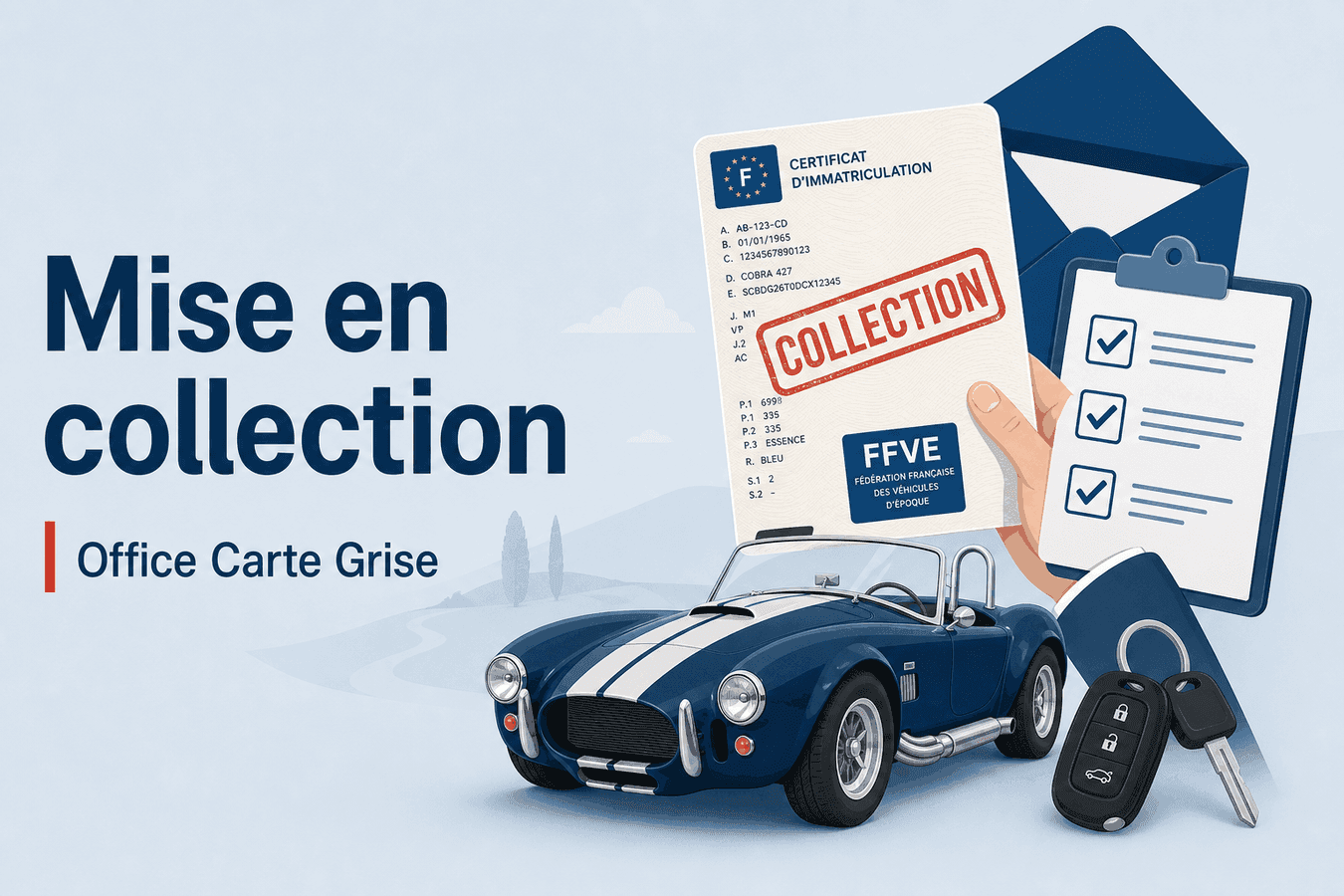
Classic registration adds the “véhicule de collection” mention to the French registration certificate. It almost always rests on an FFVE dating-and-specification certificate, then an SIV filing. Office Carte Grise, an authorised professional, builds the file for your case: current keeper, used purchase, or certificate only.

Three entry points: you already hold the title, you have just bought in France, or you only order the FFVE certificate (€60, €30 for a moped ≤ 50 cm³). FFVE review often takes four to eight weeks; the mention on the title follows.

Classic registration and FFVE certificate — Office Carte Grise

Step 1/3

Choose your situation

Current holder, recent purchase, or FFVE attestation only.

Start your application

FFVE certificate + service fee

from 90,00 € incl. VAT

  • FFVE certificate : €60 (€30 for mopeds ≤ 50 cc)
  • Service fee : €40 to €100 depending on the case
  • Registration taxes : €13.76 or based on your vehicle
Calculate your registration cost

Guide to classic registration and the FFVE certificate

What classic registration means

It is the entry, on the registration certificate, of the “véhicule de collection” use. The title remains a SIV title: keeper, address, technical data. A mention is added that changes the roadworthiness-test rules and, often, how insurers treat the vehicle.

The Highway Code (R.311-1) defines a collector vehicle by age, the end of production of the type, and respect for the original configuration. Without those three pillars, the mention has no basis.

This is not a “prestige” registration, nor a licence to modify the vehicle at will. It is a heritage status, regulated, that ANTS grants only with proof of dating and specification.

FFVE certificate and carte grise: two documents

The dating-and-specification certificate issued by the Fédération française des véhicules d’époque (FFVE) is not a registration certificate. It states age, make, type, identification number and originality. Without it, the SIV usually refuses the collector mention.

The collector carte grise (sometimes called CIC in club language) is the title issued afterwards. Ordering only the FFVE certificate makes sense if you are not ready to change the title; to drive with the mention, you need both steps.

The “certificate only” order is detailed on the FFVE certificate page. Here it is one brick of the file, not the whole journey.

The three eligibility criteria

Age is counted from the date of first registration, not from the manufacturing date. A 1994 chassis assembled late can still be too young. You need thirty full years in the year of the application.

The model must no longer be produced or marketed. A faithful restoration is not a substantial modification; an engine from another generation, a cut chassis or a body off type is.

Professional use (taxi, driving school, day-to-day goods transport) falls outside the status. The mention is meant for heritage use.

CriterionWhat countsFrequent pitfall
Age30 years since first registration (MEC)Confusing manufacture year with MEC
ModelProduction and marketing have stoppedA variant still in the catalogue under another name
OriginalityOriginal configuration; faithful restoration allowedEngine swap, wide-body kit, non-period conversion

Three cases: keeper, purchase, FFVE only

The classic-registration wizard opens three doors. They share the FFVE certificate (unless you already have one) and differ by the SIV title to produce.

Choose the case at step 2 of the procedure. A recent purchase under thirty years does not belong here: that is a standard change of ownership.

CaseGoalTypical service fee
Already the keeperAdd the mention on your current title€100 with FFVE, €40 if you have it; taxes €13.76
Used purchase in FranceTitle in your name with the collector mention€100 / €40 + taxes for a vehicle over 10 years old
FFVE certificate onlyObtain the document, without changing the title yet€60 service fee + €60 or €30 FFVE

When this is the wrong journey

Vehicle already French, under thirty years, a simple sale: change the keeper, do not open a collector file.

Import without a French title: the foreign-vehicle pillar covers tax and conformity; the FFVE is added if you aim for collector status.

Lost French title: duplicate, and possibly a vehicle identification form if the roadworthiness test is blocked. The collector mention is handled after a readable title, or in the same movement if the papers allow it.

  • Recent used vehicle → change of ownership
  • French title, new address → change of address
  • Definitive import without the mention → foreign-vehicle registration
  • Trade / stock → purchase declaration and W garage

How to apply for an FFVE certificate

The FFVE reviews a questionnaire and a photo file. Since 2023, online filing is the standard route; paper remains possible. An authorised professional can build the file for you.

The required shots are precise: three-quarter front and rear with a dated newspaper, cabin, manufacturer’s plate, cold-stamped identification number, engine in the vehicle. A blurred scan or a hidden VIN restarts the clock.

The sworn statement (downloadable model below) confirms you have not converted the vehicle away from original specification. Sign it before sending.

FFVE certificate cost and timeframe

The federation charges €60 for most vehicles, €30 for mopeds (CYCL and CL body types, ≤ 50 cm³). That fee is the same whether you file alone or through an authorised provider: the accompaniment fee is extra.

A complete file and an eligible vehicle often come back in four to six weeks, sometimes eight. “Sensitive vehicles” (replica, kit-car, thin history) exceed that calendar.

The certificate arrives by e-mail. Confirm the address: without the FFVE validation link, the document is not issued.

FFVE or a manufacturer certificate

The FFVE is not the only possible issuer. The applicable order also admits a certificate from the manufacturer or its representative in France. Some marques (Peugeot, Citroën, Panhard, Renault…) still keep archives: the document is often more expensive (around €200 to €300) and more detailed.

If you no longer have an original title and an ANTS duplicate is impossible, the FFVE remains in practice the most open path. For a still-structured marque, comparing the two is worthwhile.

We do not open a manufacturer-archives guide here. Remember only that “FFVE mandatory” is a shortcut: the dating certificate is mandatory, not necessarily the federation’s.

Keeping a mention already on the title

If the registration certificate already shows “véhicule de collection” and you buy the vehicle, the goal is not to “create” the mention: it is to keep it in the intended field (often presented as Z.4).

A sworn statement from the new buyer, asking to retain the mention, is often enough. An FFVE certificate issued before 2017 frequently has to be redone: the format is no longer accepted as-is.

If the buyer instead wants a “standard” title, reversing the mention is another procedure (see below). Do not mix the two intentions in the same file.

Most frequent FFVE refusals

  • Illegible photos, night shots, or no dated newspaper
  • Identification number missing from the manufacturer plate or the cold stamp
  • A questionnaire that denies a modification visible in the photos
  • Age not proven (incomplete foreign title, invoice with no MEC date)
  • Model still produced, or a replica presented as original
  • Professional use declared or obvious

Registration-file documents

Once the certificate is in hand, the SIV expects a readable named file. Cerfa 13750 and 13757 are generated in the online journey.

  • Copy of the current title, both sides
  • ID and French proof of address less than 6 months old
  • FFVE certificate (or manufacturer certificate)
  • Valid roadworthiness test when the vehicle is subject to testing
  • Certificate of insurance
  • If purchasing: transfer certificate 15776 or invoice, and a licence for the category

Roadworthiness test: 2 years, 5 years, 1960 exemption

To file, a recent test report is in principle required, including for many mopeds. Once the mention is obtained, the interval often moves to five years for light vehicles and two-wheelers first registered on or after 1 January 1960.

Light vehicles registered as collectors whose first registration is before 1 January 1960 can be exempt after a last test when the title is issued. The official date is 1960, not 1961.

The “collector” test is sometimes less strict on some points, but it is not a free pass: a dangerous vehicle is still refused.

SituationRoadworthiness test
“Standard” title, vehicle subject to testingEvery 2 years (3 years for some two-wheelers)
Collector mention, MEC on or after 01/01/1960Often every 5 years
Collector mention, MEC before 01/01/1960Exemption possible after the last test

Taxes: already the keeper or a purchase

If the title is already in your name, the collector amendment is generally limited to €13.76 in State taxes (processing + postage). The agency fee is extra.

If you have just bought, you pay a used-vehicle carte grise for a vehicle over 10 years old: regional Y1 tax according to fiscal horsepower and département. Estimate it with the registration cost calculator or the tax calculator.

The FFVE certificate and the plates are not in that amount.

Office Carte Grise fees

Classic registration with an FFVE certificate request: €100 incl. VAT. If you already bring a usable certificate: €40. FFVE certificate only: €60 service fee, plus the €60 or €30 paid to the federation.

These lines are separate from SIV taxes. The journey summary splits them before payment.

ANTS or an authorised professional

A private individual can file alone on ANTS once the FFVE certificate is received. The portal barely helps you choose between “amendment”, “change of keeper” and “first registration”.

An authorised provider checks the photos, generates the Cerfa forms, and chases a missing paper rather than a silent rejection. Start at step 2 of the procedure when title, identity and the FFVE file are ready — or still to be built.

Black collector plates

The mention allows black-background plates with silver characters, in the SIV format (AA-123-AA), not a fantasy return to FNI. They are engraved after the title arrives, by a maker who knows the collector rules.

Nothing requires you to switch to black: white SIV plates remain legal. The reverse is not true: fitting black plates without the mention exposes you to a fine.

After the title: the insurance contract

Tell the insurer about the change of mention. Many offer a “collector” formula (mileage, leisure use). It is not automatic: undeclared daily use is a problem at claim time.

The SIV number does not necessarily change. It is the mention that changes the contract, not a systematic new registration.

Low-emission zones and Crit’Air: a useful nuance

Collector status is not a Crit’Air pass valid everywhere. Low-emission zones are local and evolving. Some cities treat collector vehicles more gently; others restrict hours or require a waiver.

The most stable advantage remains the roadworthiness-test interval, not city-centre driving. Read the municipal order before you count on a daily trip.

Passenger car in collector status

The most common case. Category B licence, test according to age, plates of your choice after the title. An estate or coupé of the same type follows the same rules as long as the body type on the title and the FFVE certificate match.

Motorcycle and moped

The FFVE handles two-wheelers. A moped ≤ 50 cm³ pays €30 for the certificate. The licence must match the category.

Two-wheeler roadworthiness testing applies at filing when the rules require it. Do not assume a general exemption “because it is an old motorcycle”.

Van, HGV, tractor, military vehicle

The FFVE accepts cars, motorcycles, trucks, mopeds, agricultural tractors, trailers, civilian or military vehicles, as long as the three criteria hold.

An HGV over 30 years old has its own inspection rules. A tractor or trailer needs adapted photos (plate, coupling, identification). State the body type in the questionnaire.

Used purchase in France and the collector mention

This is the former “used + classic” journey, now treated as a case on this page. The title is issued in the buyer’s name, with the mention, without chaining two SIV files.

Gather transfer form 15776, FFVE (to obtain or to keep), a test less than six months old if the title is not yet yours, identity and address. In the wizard, choose the purchase case.

If the seller already has the mention and a recent FFVE, check the date: before 2017, plan a new certificate in most cases.

Imported collector vehicle

The FFVE certificate can stand in for conformity when the COC has disappeared. It does not erase the quitus (EU) or the 846A (outside the EU, United Kingdom included).

Fiscal and customs detail sits on the foreign-vehicle registration page. Here, remember only that collector status is a layer, not a substitute for import.

Barn find and missing title

Without a readable carte grise, some centres refuse the roadworthiness test. The vehicle identification form then serves as a technical identity document, alongside proof of ownership.

The FFVE needs dating: a foreign title, a period invoice, a duplicate. A bare chassis with no paper almost always stalls. This is an FIV teaser, not a second guide.

Kit-car, replica and sensitive files

The FFVE lengthens the delay as soon as the vehicle is a replica, a kit or a doubtful history. Presenting a copy as an original is the shortest path to a refusal.

State the real status in the questionnaire. An individual approval (RTI) may be required if the vehicle never existed in that form as a series model.

Leaving the collector mention

The switch is not a prison. Returning to a “standard” title is possible under conditions: often a roadworthiness test under the standard regime, sometimes a return to conformity if collector fittings no longer hold.

That is not this page’s journey. Contact us before you dismantle a file you have just built.

VIN and photograph consistency

The identification number must be identical on the title, the FFVE certificate, the invoice and the cold-stamp photos. A one-character gap blocks the SIV review as well as the FFVE review.

A manufacturer plate painted until it is unreadable photographs poorly: dust it, light it, do not crop too tight.

Mistakes that get the file rejected

  • Asking for collector status on a 28-year-old vehicle
  • Omitting the dated newspaper on the FFVE photos
  • Attaching a pre-2017 FFVE without renewing it
  • Confusing a used purchase with an import
  • Expired roadworthiness test at the moment of SIV filing
  • Promising a low-emission-zone exemption in the wrong file
  • Black plates ordered before the title

How long it takes, end to end

Two clocks. The FFVE’s: several weeks. The State’s: a few days to a few weeks after a complete SIV file.

Preparing photos and the test during the FFVE review avoids losing the month after the certificate arrives. Around shows or the rentrée, the FFVE queue lengthens.

Non-professional use

A collector vehicle is not a business tool. Daily hire, paid transport, permanent commercial demonstration: the status does not hold.

A club, a rally, a one-off exhibition stay within the heritage spirit. If you doubt the use, describe it before you pay for the certificate.

Ready to request the collector mention

Readable title, identity and French address: start at step 2 of the procedure and choose your case. We build the FFVE certificate if needed and transmit. Import, the FIV and the certificate alone are ordered in parallel on their pages.

If you have just bought the vehicle

If you are hosted by a third party

  • A signed accommodation certificate from your host
  • Your host's proof of address (less than 6 months old)
  • A copy of both sides of your host's ID card

For an FFVE attestation only

  • Purchase declaration receipt
  • Transfer certificate 15776*02
  • Carte grise
  • FFVE sworn statement (Download the sworn statement)
  • Three-quarter front photo
  • Three-quarter rear photo
  • Photo of the interior
  • Photo of the manufacturer's plate
  • Photo of the stamped chassis number (cold-stamped VIN)
  • Photo of the engine inside the vehicle

Classic registration and FFVE: frequently asked questions

Are the 30 years counted from manufacture?

No. What counts is the date of first registration. A vehicle built in 1995 and first registered in 1996 is only eligible from 2026.

Can I fit black plates straight away?

Only after the title carries the collector mention, and in SIV format. Ordering plates before issuance means you may drive non-compliant.

Is a 2015 FFVE certificate still enough?

Often not. Certificates issued before 2017 frequently have to be renewed, especially on a change of keeper.

Must I go through the FFVE if the manufacturer can certify?

Not necessarily. A certificate from the manufacturer or its representative can replace the FFVE’s. It is often more expensive and more detailed.

Does collector status exempt me from Crit’Air in every low-emission zone?

No. The rules are local. The mention sometimes helps; it does not open a permanent national right. Check the metropolitan order.

Why does a moped pay €30 for the FFVE certificate?

The federation applies a reduced fee to mopeds (CYCL and CL body types, ≤ 50 cm³). Cars, motorcycles and other types stay at €60.

The seller already has the mention: what do I provide when I buy?

Often a statement to keep the mention, plus the transfer and a recent test. If their FFVE is from before 2017, plan a new certificate.

Can a kit-car obtain an FFVE certificate?

The file is “sensitive”: longer delays, risk of refusal if the replica is presented as original. Honesty in the questionnaire matters as much as the photos.

With no carte grise, where do I start?

Gather proof of ownership. A roadworthiness test may require a vehicle identification form. The FFVE, for its part, needs documented dating.

Can I leave collector status later?

Yes, under conditions (often a test under the standard regime). It is not the same journey as obtaining the mention.

Does the FFVE certificate have an expiry date?

It is tied to the vehicle, not to a calendar year. A format that is too old (typically before 2017) is no longer always accepted in the SIV.

Do I need a driving licence for FFVE only?

For the certificate, identity and ownership are enough. A licence for the category becomes required as soon as the title changes keeper.

Does an old motorhome fall under collector status?

Yes if it is over 30 years old, the model is no longer produced and the body type on the title (often VASP) matches the original. A recent conversion blocks the file.

What is the delay after the FFVE certificate arrives?

The SIV, once the file is complete, is generally faster than the FFVE. The bottleneck almost always remains the certificate and the roadworthiness test.

Can a company request the mention?

Yes, with a Kbis, if use is not professional operation of the vehicle. Trade falls under a purchase declaration, not heritage collector status.

Does step 2 also estimate taxes on a purchase?

Yes, for the purchase case: first-registration date, power, energy, département. The registration cost calculator uses the same logic beforehand.

I live with a host — can I still switch to collector status?

Yes, with a host certificate and the host’s proof of address. The French address is still the one printed on the title.

At the end of the procedure, you receive:

  • A carte grise carrying the « véhicule de collection » (classic vehicle) mention
  • Or the FFVE attestation alone, depending on your situation

FFVE certificate: €60 (€30 moped ≤ 50 cm³).

Service fee: €100 with FFVE, €40 if you already have it, €60 for the certificate only.

Taxes: €13.76 if you already hold the title; over-10-years scale on a purchase.