Private website, independent from the French State. Our fees cover our assistance service. You can complete your procedures free of charge (excluding registration taxes) on ants.gouv.fr. (Authorisation No. 188573)

Registering a foreign vehicle in France

Putting a French carte grise on a vehicle still titled abroad is a first SIV registration — not a simple change of keeper. Office Carte Grise, an authorised professional, builds the file (tax, conformity, documents) and transmits it.

You have one month after the vehicle arrives or you settle in France to start the procedure. Once the file is complete, the State often takes four to six weeks. While papers are missing, the definitive title waits; temporary WW plates cover circulation in parallel.

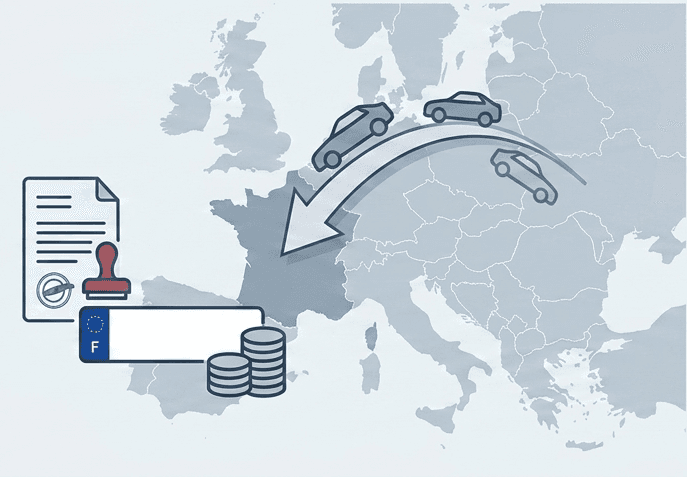
Illustration of importing and registering a foreign vehicle in France

Step 1/3

Qualify your vehicle

Check your eligibility, get an indicative tax estimate and find out whether you need a COC (€40 + the manufacturer's COC fee (varies by brand)) or an RTI approval.

Start your application

Service fee + registration taxes

from 80,00 € incl. VAT

  • Base service fee : 80,00 € incl. VAT
  • Registration taxes : Estimated during the procedure (indicative)

Guide to registering an imported vehicle in France

What foreign-vehicle registration means

It means entering a vehicle into the French SIV for the first time. The document issued is a definitive registration certificate: keeper, French address, technical data.

The starting point is not a French carte grise. It is a foreign title, sometimes in several parts, plus proof of purchase or ownership. Without that base, tax clearance, a COC and transmission all fail.

This is not the path for a used purchase already on French plates. In that case, change of ownership is enough.

The one-month deadline and processing time

User rule: start French registration within one month of the vehicle arriving or of fixing your main residence in France. That month covers filing, not the end of processing.

Once a complete file is transmitted, the examining office often takes four to six weeks, longer if a document is queried. Start tax clearance, conformity and the roadworthiness test during that calendar so you are not out of time without a usable title.

An acknowledgement and, in some cases, an SIV CPI come before the definitive title is posted.

Bought abroad or moving to France

Two doors, one title at the end. A purchase (new or used) outside France brings an invoice or transfer deed and a local title. Moving with a vehicle already in your name needs proof of ownership and French proof of address.

In both cases the address on the carte grise is the French one. The consulate of the country of origin sometimes says whether old plates must be returned.

A second home used less than eight months a year may, in some cases, stay on foreign plates. Once France is the centre of your interests, registration here is required.

European Union, outside the EU, and the United Kingdom

The country of purchase changes the tax brick, not the goal: an SIV title. The EU usually goes through the quitus fiscal. Outside the EU, Customs issue an 846A after duty and VAT. The United Kingdom, since Brexit, follows the non-EU path.

OriginTypical tax documentConformityNext step
EU (BE, DE, ES, IT, NL…)Tax clearance (quitus)COC often; RTI or FFVE otherwiseForeign-vehicle file
Outside the EU (CH, US, JP…)846A certificateCOC, DREAL RTI or classic statusForeign-vehicle file
United Kingdom846A (not an EU quitus)British COC or RTISame path plus customs

When this is the wrong procedure

Vehicle already on the SIV, French plates, ordinary private sale: change the keeper, do not open an import file.

Moving within France with a French title: change of address. Lost French title: duplicate. A trader moving stock: W garage, not a first registration per chassis.

  • Used vehicle already registered in France → change of ownership
  • French title, new address → change of address
  • French title unreadable or missing → duplicate (and FIV if the test is blocked)
  • Dealership / workshop → purchase declaration and W garage

Documents for the definitive file

The nominative file must be readable. A cropped scan or an incomplete title is the most common rejection. Cerfa 13750 and 13757 can be generated in the online flow; they remain downloadable below.

  • Foreign registration certificate, every part
  • Trader invoice or private transfer certificate; if the seller is a French trader, their foreign purchase proof too
  • Tax clearance (EU) or 846A (outside the EU)
  • European certificate of conformity or equivalent — €40 + the manufacturer's COC fee (varies by brand)
  • Roadworthiness test less than 6 months old if the vehicle requires one
  • ID, licence for the category, French proof of address less than 6 months old
  • Proof of insurance

Multi-part foreign titles

Belgium, Germany and the Netherlands often issue a multi-part title. One coupon is not enough for tax clearance or for the SIV.

Germany: Teil I and Teil II. Belgium and the Netherlands: collect every part, including the one left with the seller or the authority. The VIN must match on the title, the invoice and the COC.

Tax clearance for an EU purchase

The quitus fiscal shows that VAT was handled somewhere in the Union. Without it, definitive registration of an EU import is blocked. It is issued in the buyer's name (and co-keeper if any), not the foreign seller's.

A company or leased vehicle whose VAT was never paid: the tax office may collect it before issuing the certificate.

How to apply, which papers and the support we offer are on the tax-clearance page. Here, remember only that it is a brick of the definitive title, not optional.

846A certificate outside the European Union

Outside the EU there is no quitus. Customs issue an 846A after import duty and VAT. That document is the fiscal key to the SIV.

Switzerland, the United States, Japan, Gulf states: plan this step before you file for registration. Our tax-clearance path also steers this case when papers must be chained.

Certificate of conformity, RTI and classics

The COC proves the vehicle was type-approved for the European market. The manufacturer's fee varies; our handling is added (€40 + the manufacturer's COC fee (varies by brand)). Without a COC, two ways out: individual approval (DREAL / UTAC) or, over 30 years, an FFVE attestation.

The European certificate of conformity page covers ordering and manufacturer refusals. Classic registration and the FFVE attestation have their own flows. This landing does not repeat those guides: it places them in the file order.

Roadworthiness testing of an imported vehicle

Over four years old, a test less than six months old is normally required for the definitive title. A recent European test is sometimes accepted (except Monaco); a French lane remains the safest default.

Two-wheelers and vehicles under four years: often exempt, subject to the rules for the category.

Without a readable French title, some centres refuse the vehicle. The vehicle identification form then acts as a technical ID, alongside the import file.

Driving before the definitive title

If tax, conformity and the test take more than a few days, temporary WW plates keep you in order to drive and insure. Order them on their own page; this file remains the one for the definitive carte grise.

Registration taxes and the agency fee

Regional tax Y1 depends on fiscal horsepower, energy, CO2, first-registration date, body type and département. A malus may apply. Those amounts are separate from the handling fee (€80 incl. VAT for the registration file at Office Carte Grise).

Estimate taxes with the registration cost calculator or the tax calculator, and read the 2026 fiscal horsepower rates. State taxes are paid when ANTS confirms the amount, not on the first click.

Tax clearance, the manufacturer's COC and plates remain separate lines.

How long the carte grise takes

Two clocks. Yours: gather tax clearance or 846A, conformity, the test, readable scans. The State's: at least four weeks after a complete file, often more if something is queried.

Once the request is accepted, the acknowledgement and then the definitive title follow by tracked post. The real bottleneck is almost always upstream (tax paper, COC, multi-part title), not printing the card.

New or used vehicle bought outside France

New: the manufacturer or dealer invoice often shows VAT. It supports the quitus (EU) or the customs calculation (outside the EU). Used: transfer certificate or trader invoice, plus the full local title.

A readable mileage, first-registration date and VIN avoid mismatches with the COC. A 'new' vehicle never registered abroad is still an import: it is not a French stock registration.

Translations and readable scans

Recent EU titles are usually enough as they stand. A handwritten sale deed, an old title or a document outside the Latin alphabet may need a translation. Better to plan it than to discover a refusal after transmission.

Sharp photos, edges visible, no finger on the identification number. A front without a back, on a two-sided title, almost always comes back.

Matching the VIN and the technical data

The identification number must be the same on the foreign title, the invoice, the COC (or FFVE) and the application. One character out blocks examination.

Power, energy, body type and first-registration date feed the taxes. A mistake here skews the registration cost calculator and can send the file back.

Malus, fixed tax and other lines

Besides Y1, a CO2 malus or a fixed tax may apply depending on age, energy and the year's schedules. The tax calculator includes them as a guide; the binding amount is the one ANTS confirms.

Those lines do not appear on WW plates or on the quitus. They are settled with the definitive title.

Uploading documents in the client area

After you pay the agency fees, you upload scans from the client area — a postal packet is no longer the default. If a page is missing we ask for it instead of transmitting an incomplete file.

A tracking reference and the option to contact us stay available throughout examination.

After the title: definitive plates and the insurance policy

The French certificate carries the definitive SIV number. Have plates engraved with that number and switch insurance from any temporary identifier.

From then on, the usual procedures (change of address, duplicate, sale) are those of a French vehicle.

A co-keeper on an import

If two people appear on the title, their identities must match on the quitus (or 846A), the Cerfa forms and the ID documents. A co-keeper omitted from the tax paper and added at the last minute fails transmission.

Proof of address can be the main keeper's only, at the French address that will be printed.

ANTS or an authorised professional

A private individual can file alone on ANTS. The import path there is poorly guided: what a quitus is, a missing COC, the difference from a change of keeper.

An authorised professional checks the papers, generates the Cerfa forms, transmits and chases instead of a silent rejection. Start at step 2 of the procedure when the foreign title, identity and address are ready.

Vehicles imported from Belgium, Germany or the Netherlands

These three origins make up a large share of files. The trap is not regional tax, it is an incomplete title and a quitus in the wrong name.

Align keeper (and co-keeper) on the quitus, form 13750 and the ID. A quitus in the Belgian or German seller's name does not unlock the SIV.

Recent EU-market models often already have a COC; off-catalogue versions are ordered from the manufacturer while the rest of the file moves.

Spain, Italy and Portugal

Titles are usually a single document, easier to scan. Still check the VIN on the invoice and the COC.

Bought from a French trader who imported the vehicle themselves: ask for their foreign purchase proof, not only their resale invoice.

Switzerland and other non-EU countries

Switzerland is not an EU member: expect an 846A and conformity to prove. A European history is not automatic, even on a recent model.

United States, Japan, Canada: originally outside European standards, RTI or classic status (over 30 years) is the usual path. The definitive title waits for those inspections.

United Kingdom after Brexit

A UK import is no longer an EU flow. Customs, VAT, 846A, then conformity and the SIV file. Manufacturer and customs delays often exceed the one-month user window.

The detailed path is in the Brexit import article. On this page, remember the United Kingdom is treated as outside the EU, not as a classic quitus.

Car, motorcycle, motorhome or van

Private car: the most common case. Category B licence, roadworthiness test if over four years, definitive plates after the title.

Motorcycle: licence for the category. Two-wheeler test rules apply to the definitive file.

Motorhome and VASP: the body type on the foreign title and COC must match. An unapproved conversion blocks the SIV.

Van in a company's name: recent company extract, stamped Cerfa, suitable licence.

Imported classic vehicles

Over 30 years, no longer produced, unmodified: the FFVE attestation can replace a missing COC and open collector status.

That does not waive the tax paper (quitus or 846A) or the SIV filing. Order the FFVE attestation or classic registration in parallel with this file.

Import in a company's name

A legal entity can be the keeper of the French title. Attach a recent company extract and have the legal representative sign the Cerfa forms.

If the purpose is trading and resale, use the professional purchase declaration rather than a first registration 'as a private individual'.

Mistakes that get an import file rejected

  • Incomplete foreign title (a missing part)
  • Quitus or 846A in a name other than the applicant's
  • No COC while the vehicle is neither in RTI nor a classic
  • Foreign proof of address, or one that is too old
  • Licence for the wrong category
  • Expired test, or a test refused for lack of FIV
  • Mixing up import and change of ownership on a title that is already French
  • Waiting until the end of the user month to start tax and conformity

Ready to register your imported vehicle

Readable foreign title, identity and French address: start at step 2 of the procedure. We check the papers and transmit. Tax clearance, the European certificate of conformity and temporary WW plates can be ordered in parallel on their pages.

If you are hosted by a third party

  • A signed accommodation certificate from your host
  • Your host's proof of address

If there is a co-owner

  • The co-owner's photo ID

If the vehicle is registered to a company

  • Kbis extract (French company registration certificate)

Foreign vehicle registration: frequently asked questions

How long do I have to register a vehicle that arrived from abroad?

You must start the procedure within one month of the vehicle arriving or of settling in France. Once the file is complete, State processing often takes several extra weeks.

Do I need a quitus for a purchase outside the European Union?

No. Outside the EU, the 846A customs certificate is the fiscal key. The quitus is for EU purchases.

Is a European roadworthiness test enough?

A recent European test (except Monaco) can be accepted. A French test less than six months old remains the safest choice for a vehicle over four years old.

What does import registration cost at Office Carte Grise?

The handling fee for the registration file is €80 incl. VAT. State taxes (fiscal horsepower, any malus) are extra and depend on the vehicle and département. Tax clearance, the manufacturer's COC and plates are separate lines.

Can I register an imported motorcycle?

Yes, with a licence for the category and the same bricks (title, tax, conformity). Two-wheeler test rules apply.

Does a British vehicle still follow the EU path?

No. Since Brexit, a UK import is treated as outside the EU: 846A, conformity, then the SIV file. See also the UK import guide.

Can a company be the keeper of the French title?

Yes, with a company extract and Cerfa signed by the representative. Trading stock is rather a professional purchase declaration.

What if the COC cannot be found?

Two usual ways out: individual approval at the DREAL, or an FFVE attestation if the vehicle is over 30 years old and you want collector status. Without one of those proofs, the SIV refuses the definitive title.

Must a French trader provide more than their invoice?

If they imported the vehicle themselves, they must also give their foreign purchase proof. A resale invoice alone does not rebuild the file.

Do I need insurance before I file?

Yes. A valid certificate is part of the papers. Without a French title, many insurers rely on WW plates; the policy then switches to the definitive number.

Can I keep foreign plates on a second home?

Only if you can show a main residence outside France for most of the year (often described as eight months). Once France is your main residence, French registration is required.

Do prefectures still handle these files at the counter?

No. Filing is online via ANTS or an authorised professional. Prefectures no longer see the public for an ordinary first registration.

Does an EU company or leased vehicle change the quitus?

Often. If VAT was never paid, the tax office may collect it before issuing the quitus. The name on the quitus must stay the name on the registration application.

Which licence for an imported motorhome?

The one that matches the category and GTW. A VASP body type wrongly shown on the foreign title or COC blocks the file even with the right licence.

Can I sell the vehicle before I have the French carte grise?

It is risky: the buyer would have to finish an import file in their own name. Better to obtain the SIV title, then transfer the vehicle through an ordinary sale.

Does step 2 of the procedure also estimate taxes?

Yes. It uses first-registration date, fiscal horsepower, CO2, energy, body type and département. The tax calculator and the registration cost calculator use the same logic beforehand.

I live with a host — can I still import?

Yes, with a host certificate and your host's proof of address, on top of your ID. The French address is still the one printed on the title.

At the end of the procedure, you receive:

  • An official acknowledgement that your application has been registered
  • Your French registration certificate (carte grise)

Government processing takes a minimum of 4 weeks, often longer, once the file is complete.

The agency fee is €80 incl. VAT; registration taxes (Y.1) are added according to the vehicle.

To drive before the definitive title, the temporary WW path is separate — see /services/temporary-ww-plates/.